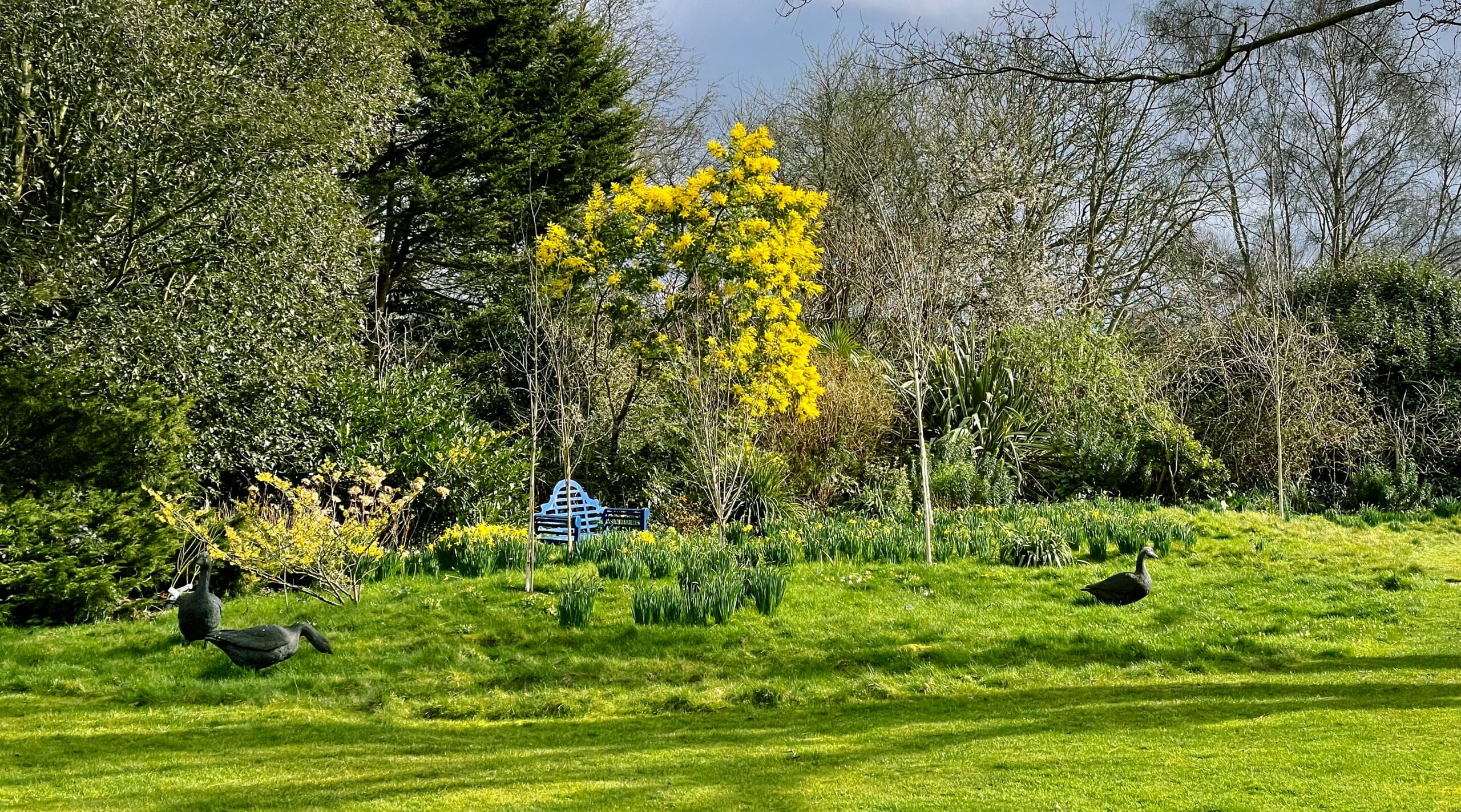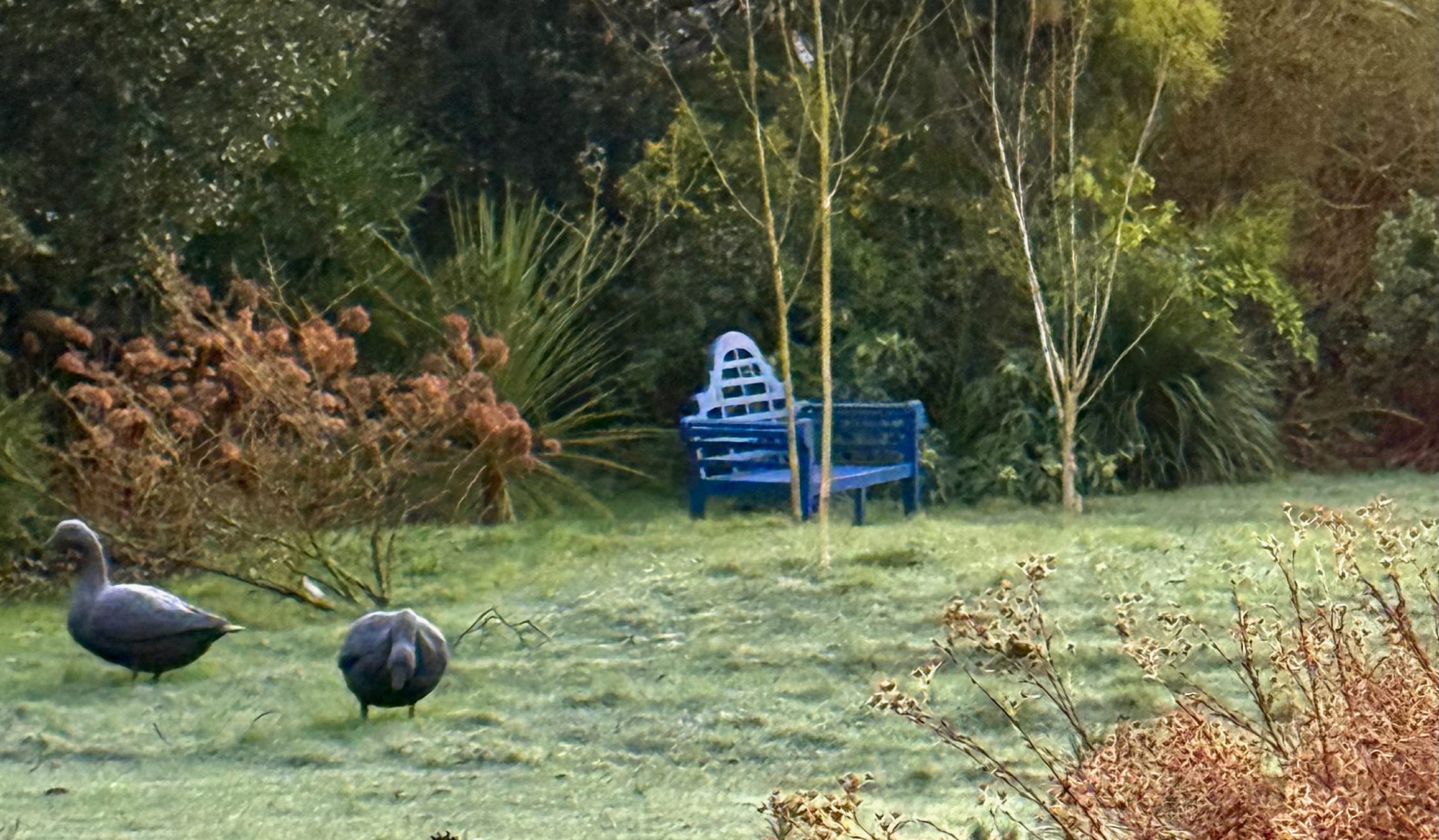
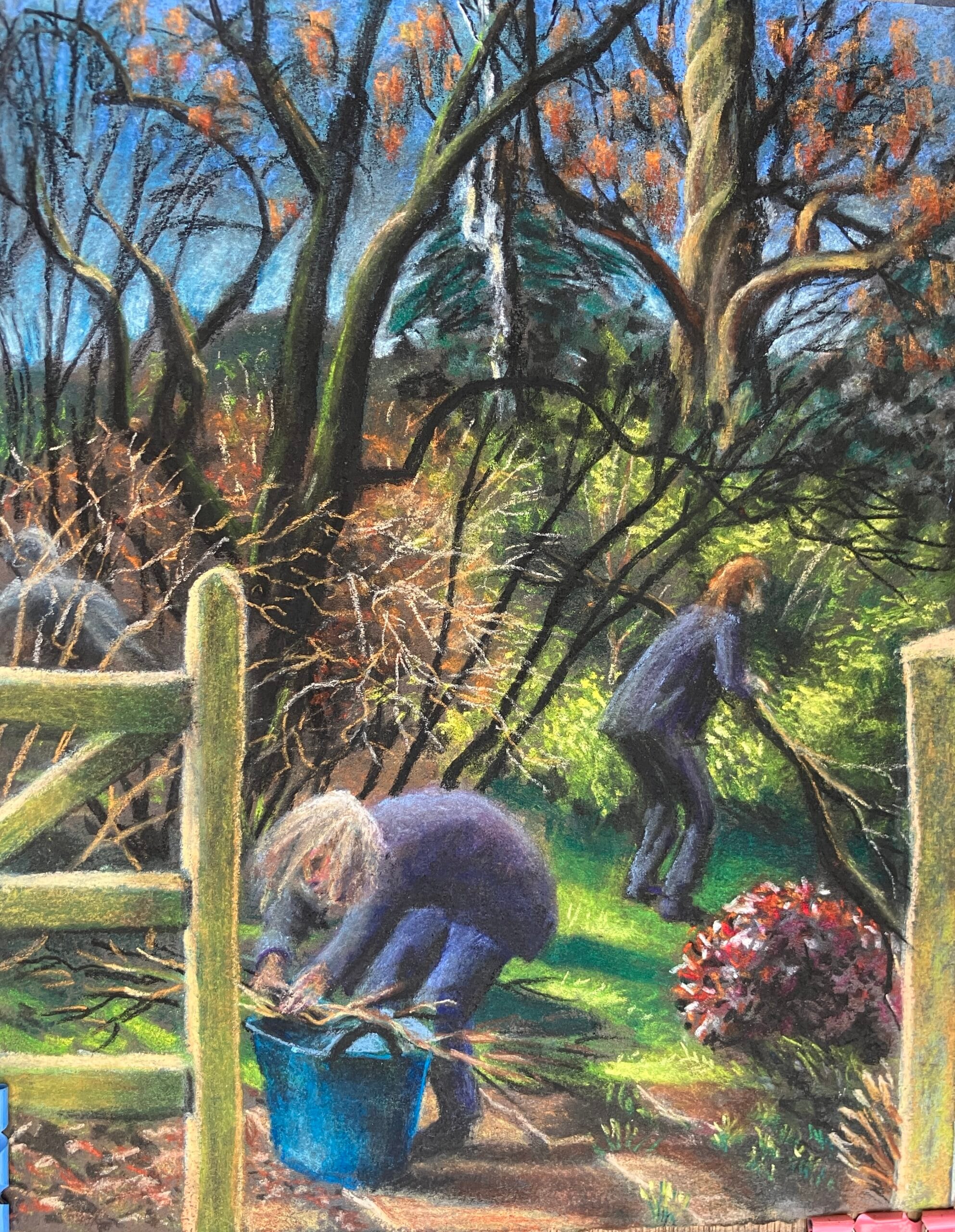
At Denmans Garden, the interplay between nature and creativity has always been a source of inspiration. Over the past two years, that relationship blossomed into something truly special through the eyes and hands of figurative painter Oscar Romp, our Artist-in-Residence. Oscar immersed himself in the Garden’s rhythms, capturing its essence through his expressive and stylistic artwork. His journey documented not only the depth of his artistic process but also the profound impact working at Denmans Garden has had on his work and daily life.
Oscar began his residency at the end 2023 and finished near the end of 2025. This his final blog, an opportunity to reflect on the experience.
Finding Belonging and Escape
For Oscar, being commissioned as Artist-in-Residence was more than a professional opportunity—it was a personal refuge. He described the residency as a rare moment of feeling truly welcomed and part of a community. Amidst the challenges of caring for aging parents and navigating the pressures of self-employment, Denmans became a sanctuary. The act of creating art in the garden offered him a mental and emotional escape, a chance to focus on something beautiful and solvable.
‘One thing about having been commissioned and invited to do the residency, is that it gives me a feeling of endorsement; when I come to Denmans, I feel I have a real place and that I’m part of the setup and my presence is welcomed. This is really refreshing for me because most of the time in my life I’ve felt on the edge, outside of the system, and the only time I really feel part of things is in situations like this when I’ve been officially commissioned’
There’s a definite feeling of escape into a situation where I’ve got a clear job to do, and I’m invited and accepted by those around me working on site. it’s also an escape for me in that when I engage in an activity like making images and art works, it’s such an engrossing process, that while you’re working, you’re only concerned with the activity in hand to the exclusion of everything else.
Art in the Elements
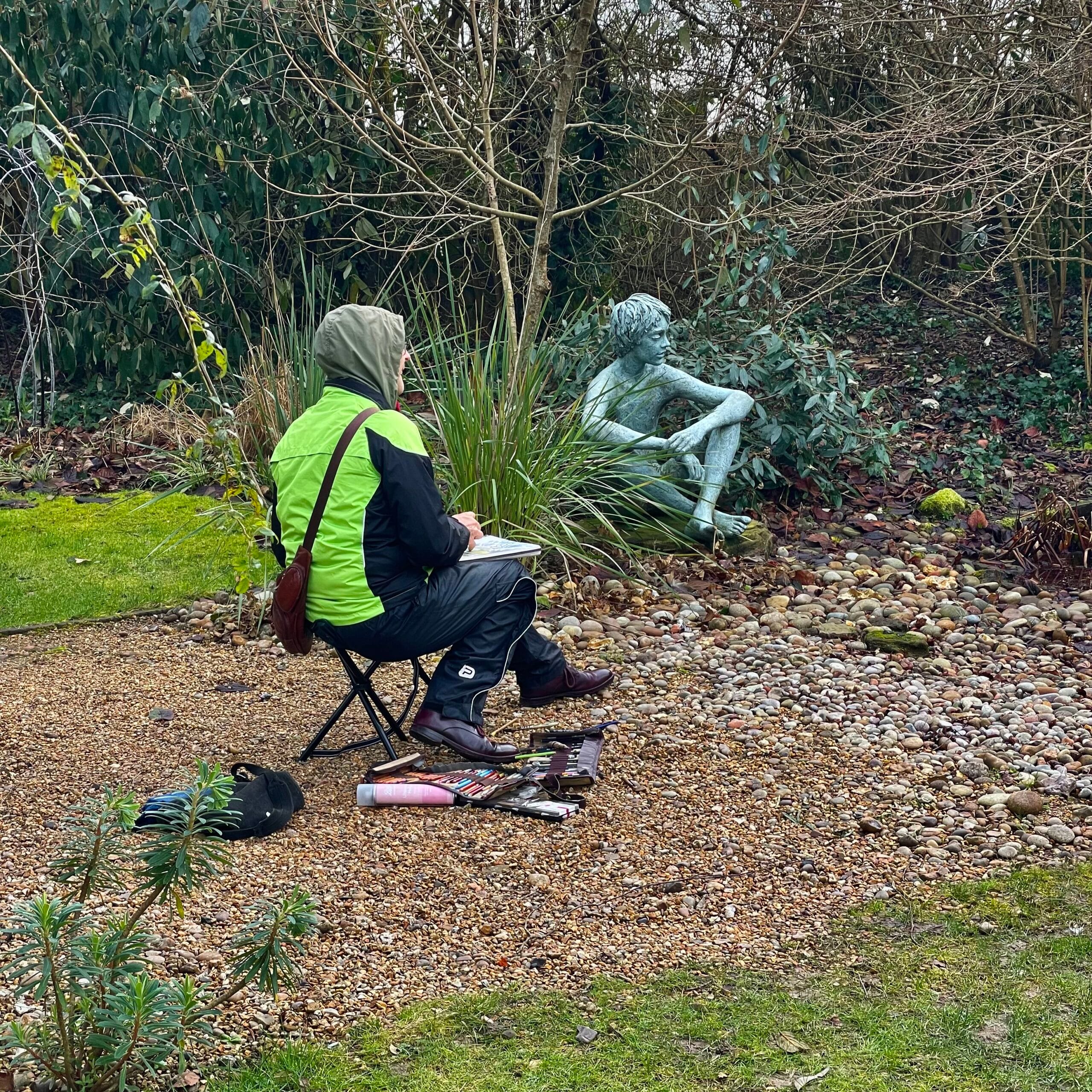
Oscar Romp sketching by the Pond on a chilly Winter’s day.
Oscar’s creative process is deeply rooted in the environment. He worked on-site in all seasons, adapting to the whims of weather and light. From sodden winters to sun-drenched summers, each visit to Denmans brought new challenges and inspirations. He often worked quickly and intuitively, capturing fleeting moments with charcoal and pastel. The changing seasons influenced his palette and mood, from monochrome sketches in winter to vibrant pastels in summer.
Capturing Humanity in Nature
While nature was a central theme, Oscar’s work also incorporated human presence— a constant in his work. In this case capturing volunteers tending the garden, visitors strolling, or even a mechanical rat amusing children and dogs during a family gathering. These elements add warmth and narrative to the pieces, reflecting the garden as a lived and shared space.
‘Most of the images I’ve made have been focused on nature, configurations of trees, shrubs, and the way they interact with the lie of the land within the Denmans site and also on its edge, and down the Lane as you approach Denmans. So most of the images are concerned with nature, even when the design shapes of the lawns echoing the riverbed curves which are man-made interventions. It’s still nature. It’s still grass that you’re drawing and trees, even when the trees are sculpted or planted in certain places through choice rather than accident of nature. But I always like to somewhere in the image, give a hint of humankind and their activities. I don’t really want to go down that rose-tinted sentimental image of the perceived past where nature was undisturbed by humans. There is a lot of sentimental art where human influence is edited out. That’s not me. So, I like to include an airplane contrail or a bike propped up against a tree. Fairly gentle reminders in the case of the Denmans works.
‘There is always a battle going on between chaotic and infinite nature versus the design and aesthetic of the gardeners and designers. Our gardeners are interested in making gardens that have organic, flowing shapes, which again comes from nature. So, there’s circles within circles, you know? This tension and disorientation is a thing when I draw. People think that I draw accurately, and isolated bits are very accurate, but then other bits are not or they’re in the wrong place. It’s quite difficult to coordinate things in the right place. And I often spend quite a lot of time locating objects on my picture ground, deciding what to fit, what to put where, and how to fit it together. And I’m always cheating because I want to put elements in the one picture that don’t really fit within the frame photographically. So, I cheat and I squash things up and I pull things out so that I can get the arrangement that I want. I do that consciously, but I’m also imperfect and I make mistakes all the time and just get things in the wrong place. These accidents and design are interlocking all the time in my art as they are in the constant evolution and shaping of the garden.’
Style, Spontaneity, and the Dreamlike
Oscar resists the notion of having a defined style, viewing it instead as a byproduct of his materials, mood, and environment. His works often carry a dreamlike quality, shaped by shifting light and the urgency of live drawing. He embraces imperfection and spontaneity, often revisiting and reworking pieces to preserve their initial energy while refining their message.
‘When I’m in the situation, I have a clarity and I can’t hang about. I have to act and a momentum builds that I can’t really reproduce in a studio situation. A lot of it is to do with a time limit and dealing with various practical problems that you have when you work on site, not least the weather. Until I worked on the Denmans residency, when I worked outside I always waited until we had stable enough weather to be outside for five or six hours where I could draw or paint continuously. Making a work is incremental. There are steps, aren’t there? You begin a work and it may be a successful beginning, and you’ve made a couple of steps. But what you’re aiming for is five, six, seven, eight, nine steps further ahead. Of course, people don’t see that. They don’t know what your intentions are. They don’t know what you’re really feeling and seeing and what you’re trying to get down in your image. They only see the end result and what it means to them. And sometimes what you’ve done is more interesting and more engaging and more significant than that idea that you were chasing down the rabbit hole. These are the kinds of concerns that that are in my head when considering and deciding whether or not to work into a piece more or not after leaving the site and going into the studio. You can easily ruin a work. It’s a gamble.
People often talk about a sense of movement in my work, even when I’m drawing things that are supposed to be still, like gardens and woods and landscapes. I wish I could say that I had a technique and I did this on purpose, but it’s not true. It’s an unconscious thing. And maybe the sense of movement comes from working fast, using faster marks, when working live. Also, light conditions come in to play. Perhaps it’s the lighting of my pictures that makes them seem dreamlike, even when I’m working on site, and it’s basically an observational drawing. It still has this dreamlike quality. And I think it’s probably to do with that when you work outside, the light is constantly changing, and you are drawing or painting, and the light when you started is not where it is when you finish’
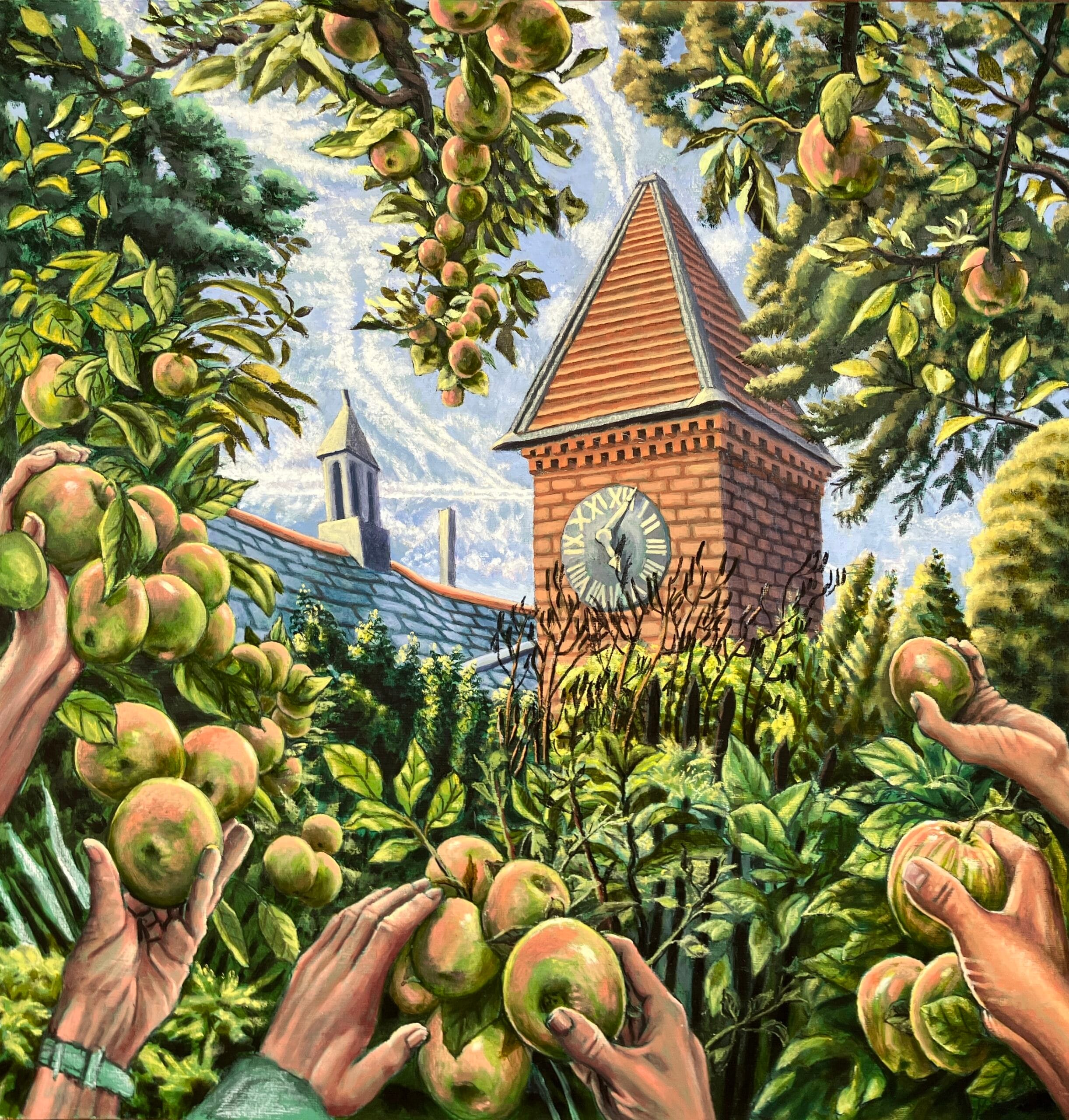
‘Apple Picking Allegory’, Oil on Wood Panel, 64 x 66cm, 2025
The Story Behind ‘Apple Harvest with Green Hands’
One standout piece from the residency is ‘Apple Harvest with Green Hands’, a work that evolved over many months in Oscar’s studio. Inspired by a photo of Denmans’ crab apple tree and his own experience picking apples with his mother, the piece blends observation with imagination. Hands reach into the frame, inviting viewers to become part of the scene—a metaphor for participation and connection.
‘I was talking to Gwendolyn about how I’d like to do some more involved, transformative works in the studio on the back of the live drawings that I was making on site. She sent some of her own photos of the Garden that she particularly liked that might be useful for me. She emailed one of her photos which had caught my eye, of a crab apple tree in some bright late Summer sunshine. It’s an interesting composition because what happens is you get a view of the Clock House which is framed, almost like a laurel wreath. It’s framed by branches and fruits of the crab apple tree. There are dozens and dozens of tiny, yellow crab apples. They frame the view of the Clock House, which is in the middle distance beyond. The photo stood out as a potential composition and motif for a different kind of painting, I thought.
A few weeks later, I selected a square-shaped wood panel, primed to mid-green to paint on. I very hastily sketched out the main shapes of the composition from the photo with the foliage framing the shape of the Clock House. And I just painted in where the sky meets crab apple wreath and the roof of the Clock House. I thought — Jump straight in! Get the paints out in the opening stages. Don’t over-think! I painted a bit, you know, some blue sky, with some half-hearted locational marks in charcoal as a rough guide. But the wind left my sails and I went blank. And then I just left it. It was very hastily done, a few painted marks, some brown outline where the building was, a bit scrappy and slapdash. And I just left it for another month or so.
And then, I just got stuck. I just thought, “Well, what am I doing here? It’s no point in just copying a photo. What’s the point of that? What’s the idea here? I had no answer, so I just left it again for another month. All of a sudden, it was late August into early September 2024 and our garden apple tree in Bognor was full of ripe, ruddy fruit. Mum and I had to pick them. As I write this, another year’s shot by, and now the apple tree is really laden with apples again! A real bumper crop!
So, I was seeing our hands reaching and plucking the apples and I thought, “Ah! This is an idea that could kick-start my becalmed studio-painting. The apples that grew in my painting were not the small clusters of yellow crab apples from Gwendolyn’s photo. They’re more like the big, red and green apples from my mum’s tree.
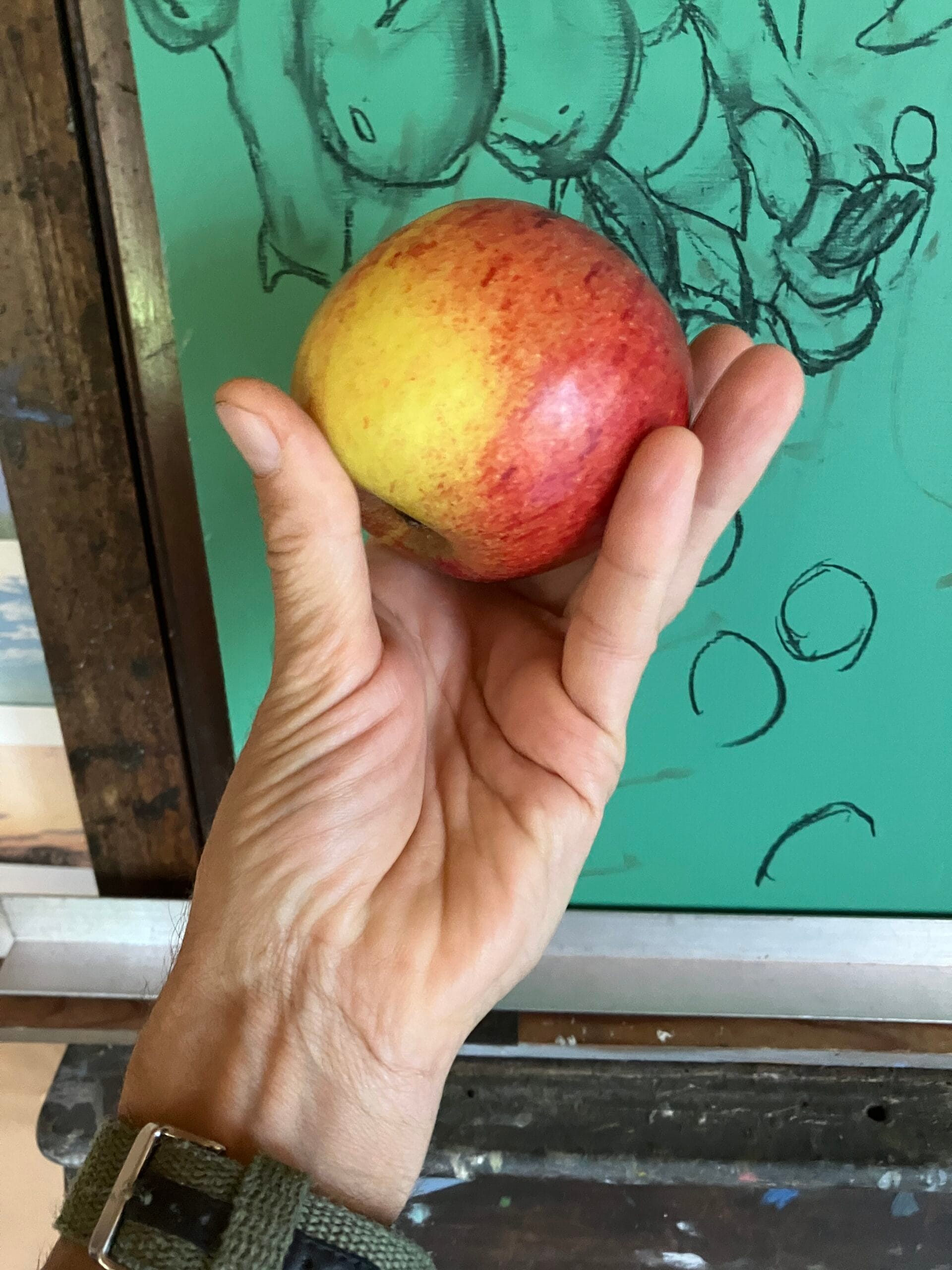
The inspiration for “Apple Picking Allegory’.
The introduction of the apple-picking idea opened a route to a more imaginative painting, that went beyond just an interpretive ‘treatment’ of a photo. There’s something symbolic about hands picking apples, I think. Not in any Biblical sense. I see something nurturing. So, maybe there’s a gardening allegory in there. Anyway, I think the unusual composition invites the viewer to think of it in terms of a story or a happening being told. There isn’t a specific, intended narrative to be interpreted, but when there’s something going on in a picture, something active, it invites the viewer to interpret more actively and read the picture in terms of a story. Once I’d introduced this idea of hands coming from the edge of the picture, (coming from outside the picture, into the picture to pick the apples and bring them back out, into the real world from the painted world), the painting started to move and develop again.
Throughout my drawing and painting career, I’ve played with this idea of bringing the viewer into a picture by including bits of myself into the picture (my hands, my legs, or both). I’m the image-maker, but also a participator in the scene depicted, and I invite the viewer to inhabit the experience too. It’s the idea that the subject or the idea goes beyond the picture and becomes part of life.
As I worked on with the apple-picking, I found I was able to, gradually work on this small, broken chunks of time; a half an hour there, a 20 minutes there feathering it in with other tasks and commitments like house-jobs, other self-employed work, helping mum and dad with stuff, like driving them to hospital appointments. It’s been a very broken up kind of time, but I found a way to adapt to that state of affairs by adapting the way of working. So, I just it is working in charcoal and pastel into the apple pickers, I could gradually develop the image over months. I took some iPhotos of my mum and I picking the apples; just the hands alone, – picking the apples, and I printed them out for painting references. I then experimented with different ways of incorporating them in the picture, from the edges, inwards until I could find a composition design that worked.
This reflective image-growing process went on for a couple of months with uneven gaps, just nipping into my painting shed and working on it when I had a random time-space. In the studio there’s far more pausing, reflection, compositional experiment, and tweaking than I ever do when working live onsite. This structured composing approach to picture making is a bit like a collage, – rotating and moving shapes about until you find satisfying or dynamic location on the canvas. The studio work process is more hesitant, more reflective, and more structurally complex I work slowly and more carefully. The marks themselves are slower and more careful.
So, the apple-picking got to the point where it was more or less completed as a monochrome image of greys and greens with light and dark from chalk and charcoal over the mid-green ground. I could have left it like that, and to anyone else, it would have looked finished. I took some good photos, so I can make a print of it like that. But I wanted a painting with the lighting and mood nuances of coloured paintwork. And so I took the risk of ruining what I had in order to make something even better.
It’s by now June of 2025 and I’m trying to finish and frame work for the August end-of -residency exhibition. I started working area by area, layering up thin glazes of oil colour, often transparent, by mixing them with a transparent matte painting medium, I find gloss finishes very off-putting when you’re working. And it’s a nightmare to photograph because of the reflection so, I tend to try and keep everything matte. I also like the way matte colours absorb the light. At this point, I noticed the artwork was losing the vitality of the charcoal & chalk under-drawing and this was bothering me. I also started to get obsessive about structural detail and particularly the architecture and brick work of the Clock House, which didn’t need to be photographic. It needed to stand up and convince me of its solidity. It needed to work. I diligently painted the brick pattern but with far bigger bricks than what it had in reality. That doesn’t matter to me. What does matter is that it’s a convincing structure. I used some thicker, more opaque paint on the hands. and start to bring a bit more contrast with the colour, painting brighter yellows where the sun’s hitting the apples; darker shadows where the hands are shading leaves behind.
Soon it was five days before the exhibition was open. I still wasn’t finished! I still wasn’t satisfied. And ah! It was still looking a bit dead and un-together. And in the end, I got frustrated with the paint, and I just thought, “Do you know what? I haven’t got time for this! Get the charcoals out again.” There’s one bit where there’s this silhouette of a dead plant the against the red brick red surface of the Clock House. And it punctuates in the view in Gwendolyn’s original photo and gives you a focus line. I needed that form in my painting too to sort of anchor it but when I tried to paint it, it was all too hesitant and twiggy, you know? It was taking too long! I got frustrated, So I grabbed some dark compressed charcoal and some thin charcoal sticks, and I ended up just drawing them in quickly and strongly, and this time it worked. And there’s other parts of the image where I just got frustrated with the hesitancy of my use of oil paint and just went back to charcoal adding bits of soft, bright pastel here and there as well. All of this painterly jiggery-pokery required longer painting sessions now of 4 or 5 hours: I guess the deadline made me do it.
You would usually have a technical problem painting oil paint over chalk pastel and charcoal. It disintegrates and disappears into the air before your moving brush. Anticipating this, I just heavily spray-fixed the charcoal/pastel drawing on the wooden board after I’d finished the drawing, before using fresh wet paint over the top. Good quality pastel fixative solidifies and stabilises your pastel work, with minimal change to the actual work. It always drops back a bit. Your opaque colours will drop back and go a bit transparent. The overall contrast tends to increase a bit and the image as a whole darkens a little. Once it was stabilised in this way, I found that oil paint worked fine over the top without disturbing the underneath layers of pastel-chalk and charcoal. Neither did the charcoal/pastel run on contact with wet paint. If I hadn’t fixed it, it would have all run into the paint and made a dirty mess. The technique of painting-over an ‘under-drawing’ worked. But as I said, it just got it got rather stilted. My hesitancy comes across too much and it reads as lifelessness and so, at the end, I had to funk it up with new energy and risk-taking and that’s where I am with it now. I sort of got halfway got there. I still don’t think it’s properly finished, but it’s close.
‘The apple-picking painting was the strongest effort I made to find different ways of working. And it is more consciously narrative, imaginative, and dreamlike than most of the works I made on site. I’ve never tried to draw in pastel and charcoal onto a primed a green primed wooden board before, for example. I would like to be able to more fluently mix different media in the same picture; I have done so in this painting, but in a quite laboured and defensive way. The imaginative element is for me nothing new, though, and this type of complex, collage-like composition is an approach I used a lot in the past, in my early etchings and later on in the murals and site-specific paintings I made from the 1990’s onwards.
The idea of using multiple media in one artwork is very appealing. You’d think it should ‘free you up’ and everything but when I try to do that, I just find that the different media tend not to align very well, and I’ll end negating one material with another, rather than getting them to work aligned and together. The use of grey chalk and charcoal tones over a green ground was a departure, and sort of worked. And yet I wanted to go on. So, I threw the dice and took the gamble, risking the success I’d already had to try to make something even better. I don’t know if I succeeded. Decide for yourself. My Dad preferred the earlier green monochrome state, whilst its later, full colour state has much more popular appeal but that doesn’t actually mean that it’s a better picture.
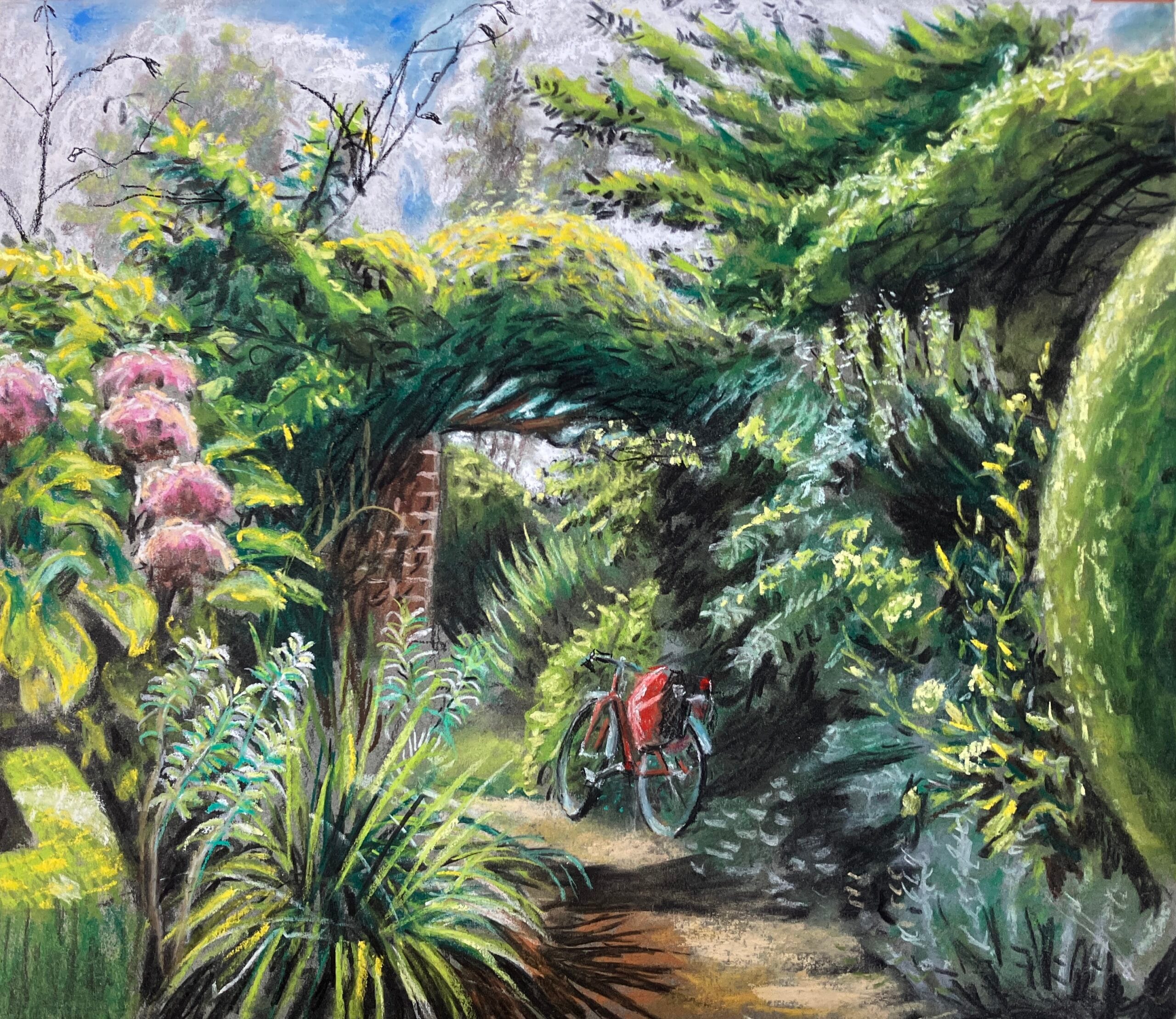
‘Through to the Meadow’, Pastel and Charcoal, 37 x 37cm, 2025
A Lasting Impression
‘There are various spots at Denmans that for me are that for me are particularly engaging. There’s the corner with the gate, known as Thieves Gate. There’s another corner of the garden I call The Enchanted Place. A third location that draws me to it is the Walled Garden. The way that you look through the doorway in the wall at the Garden beyond. The doorway frames the Garden. What I like about Denmans is that there’s never a fixed horizon line. It’s up and down and all over the place. I like rolling landscapes. I don’t really like flat horizons. The view through the Walled Garden gate is a great example of that kind of interplay because you look through and you can see the sky through the doorway, and then you look above, and you also see the sky above the wall. The Meadow beyond also made a subject for a painting in June 2024. when it was alive with large Michaelmas daisies in flower. This patch of wild grasses is in that dry riverbed feature, – where the Denmans’ gardeners have let it grow wild through Summer without mowing, and they help it along by seeding some wild flowers there too.
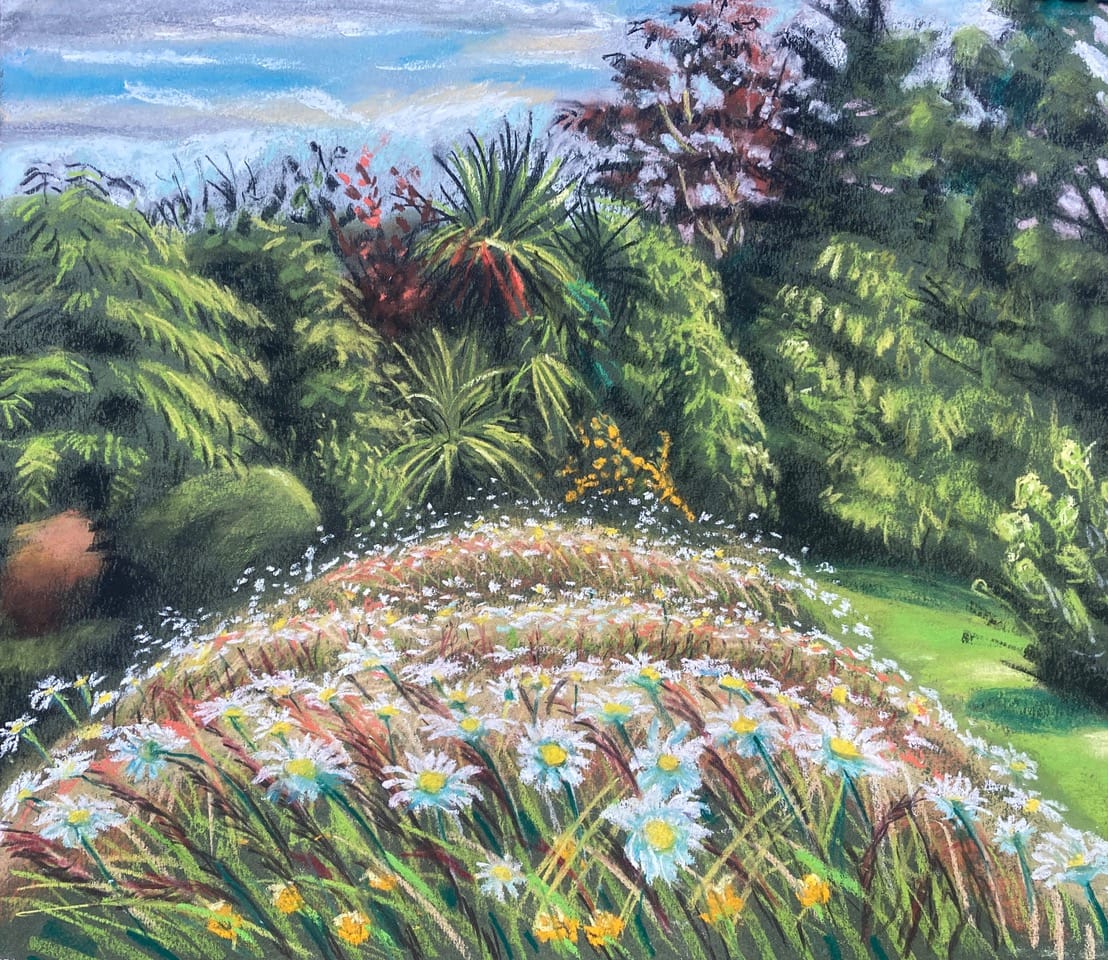
‘The Meadow Waiting for Butterflies’, Pastel and Charcoal, 37 x 33 cm, 2024
What’s important to me is that it’s readable, not whether it looks pretty. And it’s the same approach with my art. I don’t care about style. I don’t care about slick marks as long as the marks are communicating something. And that something may be awkward. I think I have a lot of awkwardness and a lot of frustration. It doesn’t come easy to me. And this probably comes out in the images.
My lasting takeaway is that you’ve just got to keep going and keep working, even if you’re not aware at the time of a development and a significance in what you’re doing, when it all comes together and amounts to a body of work, you look back and you realise it means something. There was the daily slog of getting myself to Denmans and facing the weather and doing the work, even when I didn’t feel like it, which was, to be honest, probably most of the time. I never feel like it. But you mustn’t listen to those thoughts and negative criticisms that you put on yourself. You just have to learn to knock that away. Once the momentum builds I realise I’m enjoying it. It feels like an uphill struggle until you collate everything at the end of a two-year period, and you realize that you have travelled. Whether or not my technique has progressed and whether or not I’ve had any kind of big catharsis, I don’t know. But I’ve travelled, and that’s enough, you know?
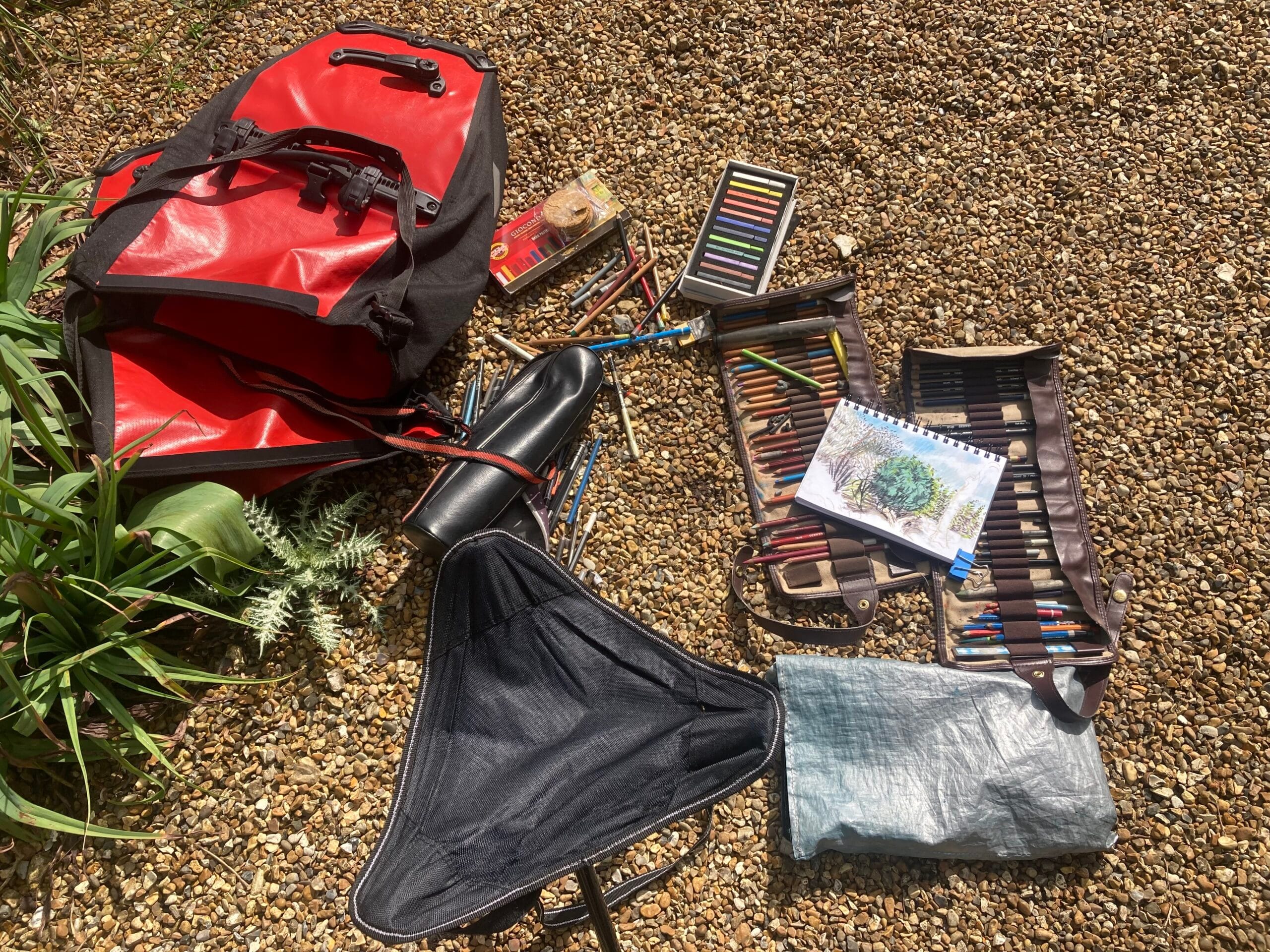
Tools of the trade.
Oscar’s time at Denmans has left an indelible mark on how we look at the Garden, and on his artistic journey. His reflections remind us of the power of gardens to heal, inspire, and connect; as a place of refuge. As he looks ahead to new projects, including potential cityscapes and rewilding sites, his work continues to explore the dynamic relationship between humanity and nature.
We are grateful for the vibrancy and insight Oscar has brought to Denmans and look forward to seeing where his path leads next.
For more information on Oscar go to https://www.oscarromp.co.uk/
@oscarromp