John Brookes often used plants with different coloured leaves in his planting designs to brighten dark corners, create contrast, and to ‘punctuate’ plantings. He especially loved using plants with silver foliage to break up plantings with a lot of greens.
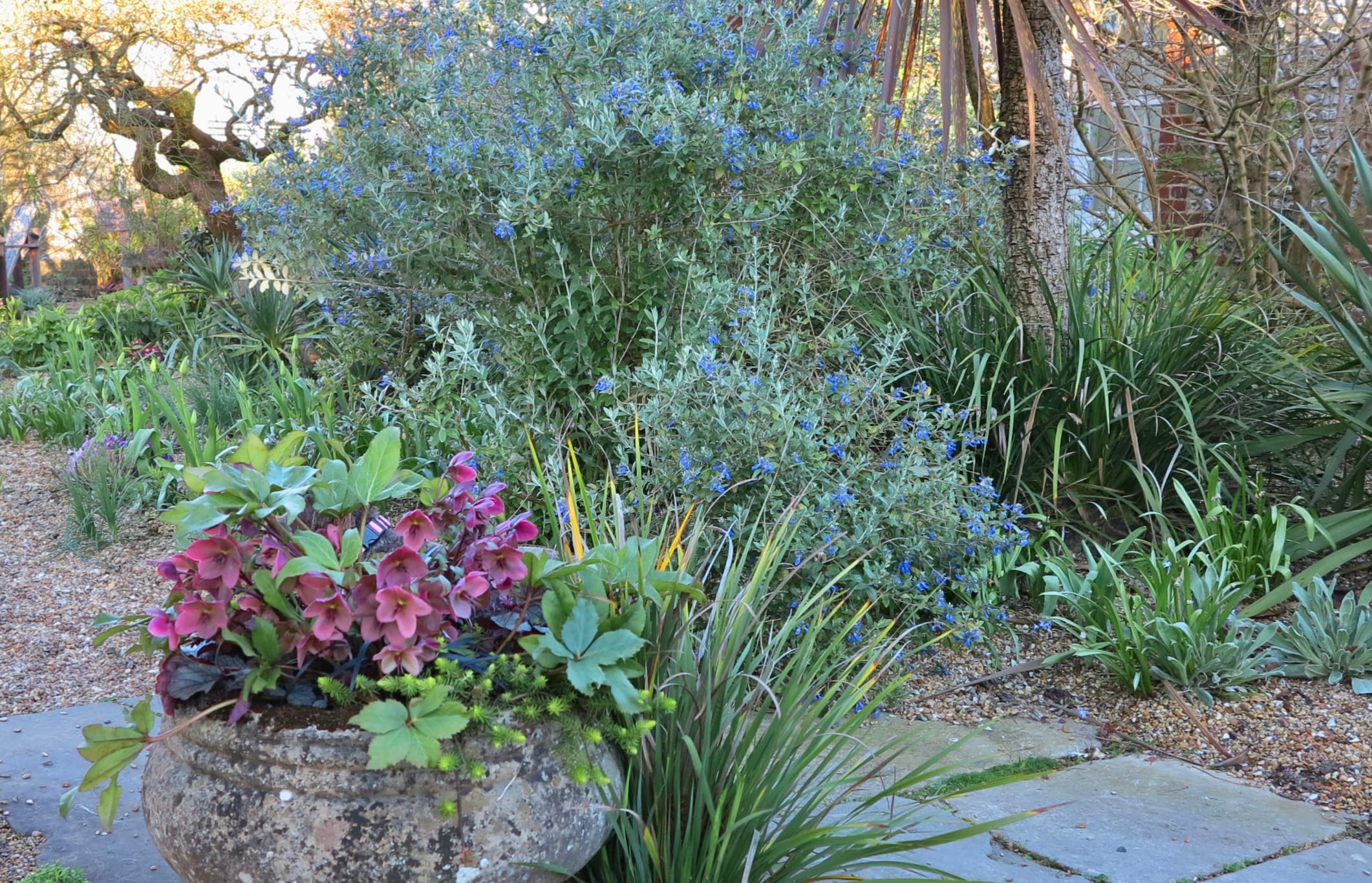
One of our favourite silver-coloured shrubs is bush or tree germander (Teucrium fruticans). A member of the mint family (so are lavender and salvia), this germander is native to the Mediterranean and Morocco and so thrives in hot sunny or mostly sunny locations with well-draining soil. Its small pointy leaves grow along white, downy stems, and are grey green with a silvery cast. Unlike some silver-leafed plants which suffer in Winter’s wet, soggy conditions, they look fantastic all year-round. In fact, its year-round beauty ticks another of John’s boxes, as he predominantly used plants with several seasons of interest in his plantings.
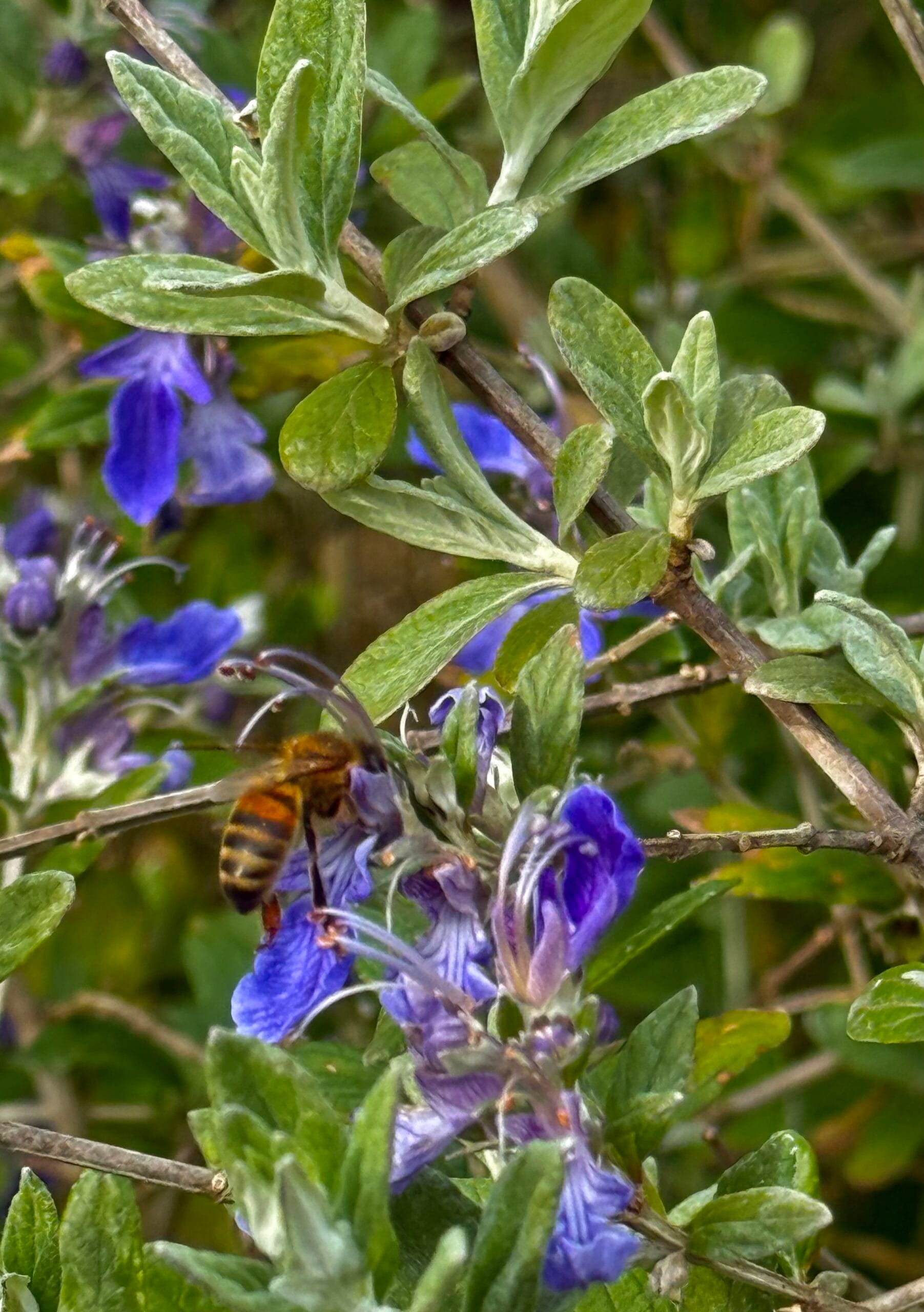 Our tree germanders, which grow in the Cottage gravel garden, start blooming here in late winter and will continue to bloom well into early summer, much to the pleasure of our bee population. The flowers, which appear at the tips of the branches, are small and pale blue, the perfect complement to the gray leaves. They are unusually shaped, reminiscent of some salvias or even orchids, and are abundant so that even though they are small, they are easily seen from a short distance. The delicate combination of silver and light blue combines well with most colours in the garden, including red-leafed plants, dark and light green plants. It’s fine texture combines well with spikey plants, broad leafed plants, and grasses.
Hardy to -5°C (23°F), this shrub grows up to 1.5 – 2.5m (5 – 8 ft) tall and 1.5m (5 ft) wide and can be left to assume a natural shape in a naturalistic setting or can be shorn into a hedge in a more formal setting. In France it is often pruned in softer, and rounded forms or even used for topiary.
Despite its rather elegant appearance, tree germanders are tough, even to the extent that they tolerate salt-spray so are suitable for coastal spaces. They are mostly drought-resistant, wind-resistant, and deer resistant, and are not ravaged by various pests. Two words of caution, however: One is well advised to wear gloves and long sleeves when pruning, and although this germander is related to mint, it is toxic and cannot be eaten.
The Latin genus name derives from the first king of Troy, Teucer, and the specific epithet, ‘fruticans’, is derived from the Latin verb for ‘becoming shrubby’.