 Shrubs and trees with silvery leaves are often a terrific complement to mixed borders because they contrast well with both dark green evergreens and deciduous plants.
Here at Denmans Garden, we have various types of silver shrubs and trees, ranging from eucalyptus and olive trees to spiky astelia and yellow flowering senecio.
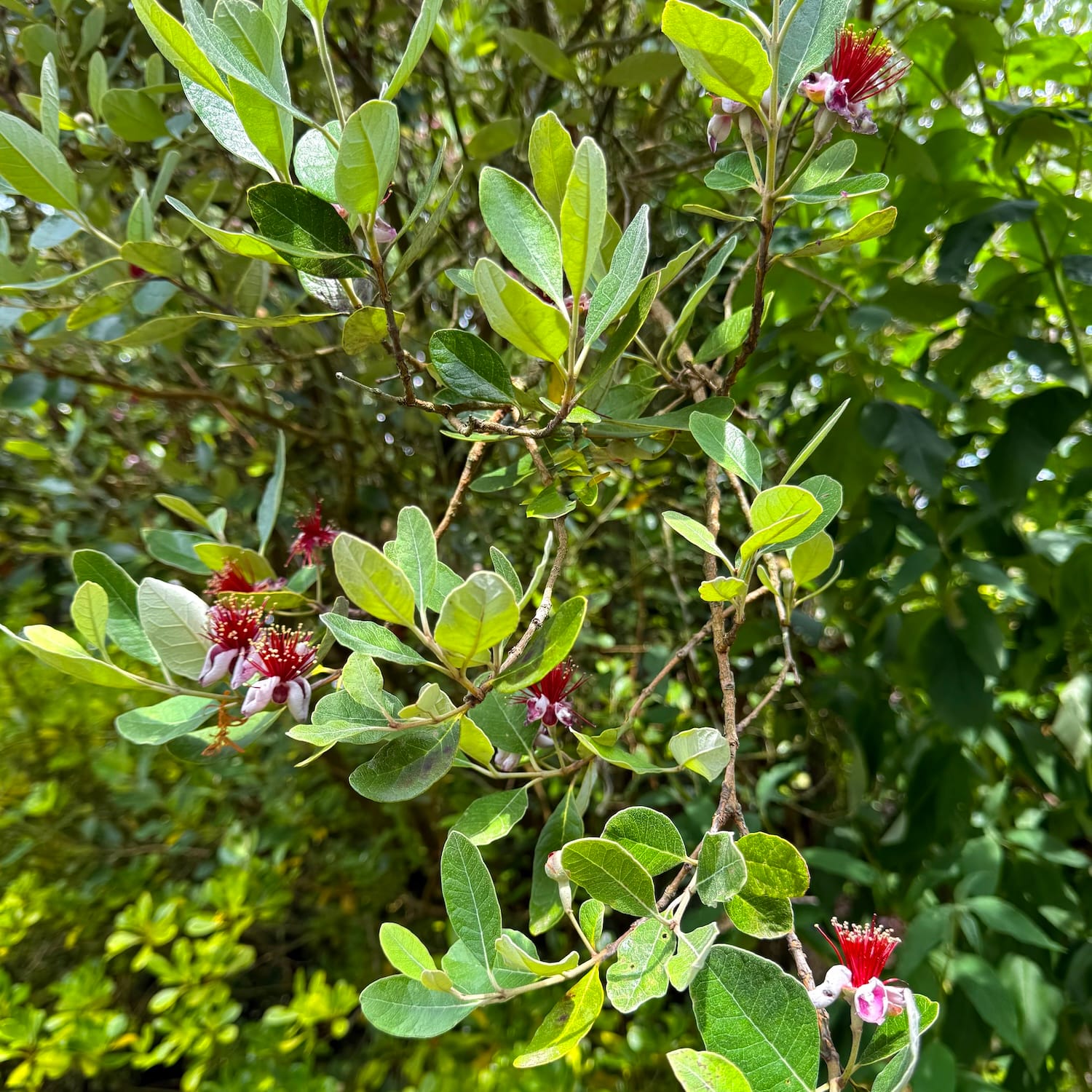
We also three large specimens of the pineapple guava or Feijoa sellowiana. Native to the mountains of southern Brazil, northern Argentina, western Paraguay and Uruguay, the pineapple guava is a slow growing shrub with evergreen leaves that are green on the top and silvery underneath. The dual colouring makes them especially lovely when they flutter on a breezy day.
In late Spring Feijoas (pronounced ‘fay hoe ah;) bear small exotic flowers comprised of four light pink petals surrounding a paintbrush like cluster of bright cherry-red stamens tipped with yellow. Though small they are quite eye-catching and apparently are edible and sweet, good additions to a summer salad.
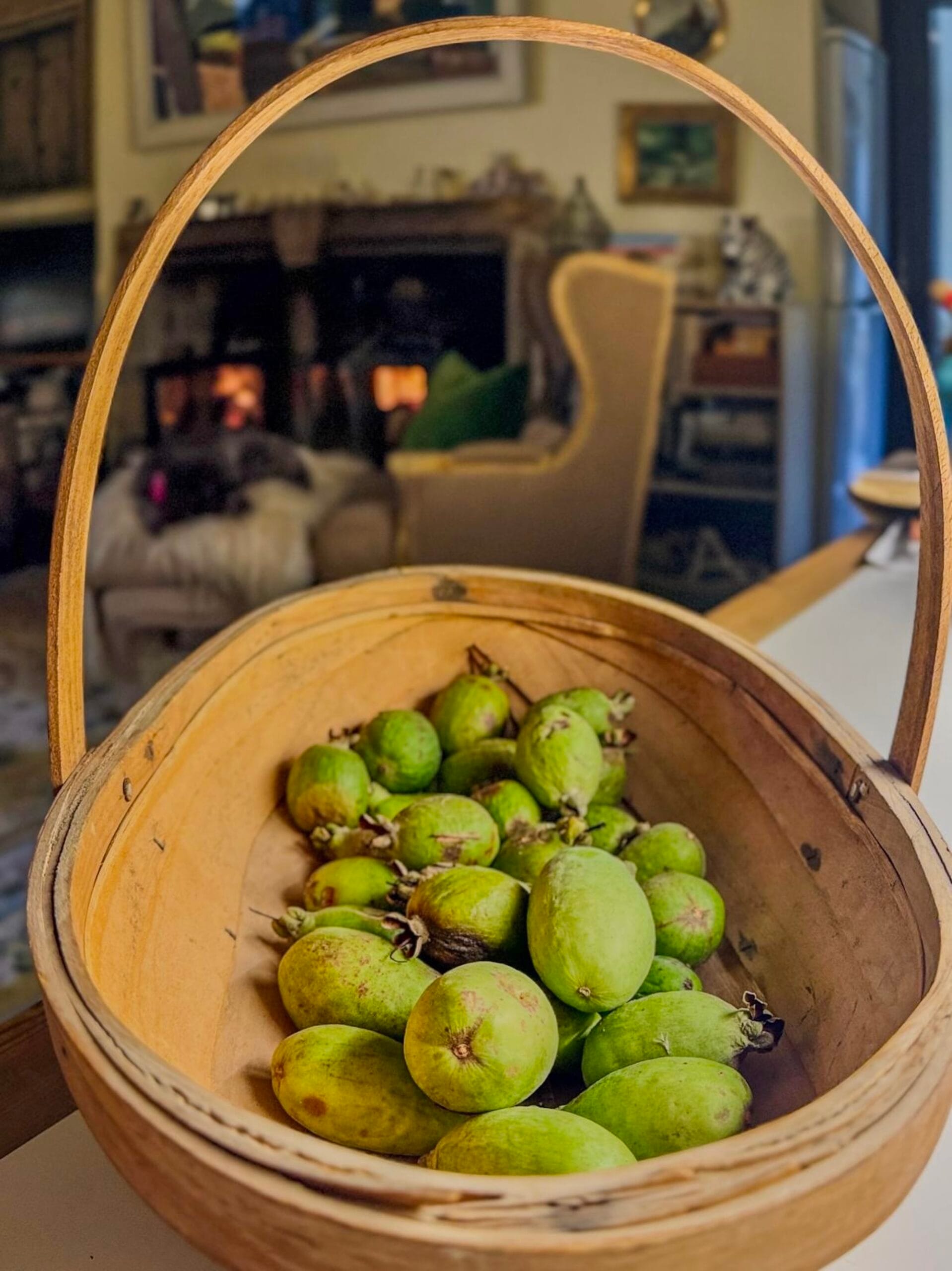
Fruits appear in late Summer. About 3 inches long and shaped like skinny pears, they are a dull green with a waxy peel. They don’t look very promising, but their flesh is remarkably sweet, tasting of a combination of pineapple, guava, strawberry, and perhaps a bit of mint.
We had never given them much thought, but there were so many this year that I was compelled to find out more about them. I was astonished when I learned t they were edible. When I tasted them for the first time the flavour reminded me of a long-ago childhood sweet. Delicious!
Pineapple guavas will grow as tall as 10-15 feet and can be used as specimen shrubs or trees, in mixed borders, and as hedging. They respond well to hard pruning, growing nice and dense, but pruning at the wrong time of year and over pruning will reduce fruit production. They can take light shade, but fruit better in full sun. Hardy to -5°C (23°F), they prefer moist, well-drained conditions and tolerate a wide range of soils. The better the soil, of course, and the warmer the weather, the better the fruits. Tolerant of drought and salt winds.
Pineapple guava Latin name derives from the names of an 18th C Peruvian botanist, da Silva Feijo, and an 18th C German plant collector, Friederich Sellow.